
The Unexpected Desert
A day at the seaside often conjures up images of sandy beaches, a calm sea, and gentle waves lapping at the shore.
We all love the thought of sandy beaches. Still, there is a place where the beach has forgotten that it is supposed to be just by the sea, and stretches half a mile or more inland with rolling dunes and scrubby bushes that manage to survive in a most inhospitable environment.
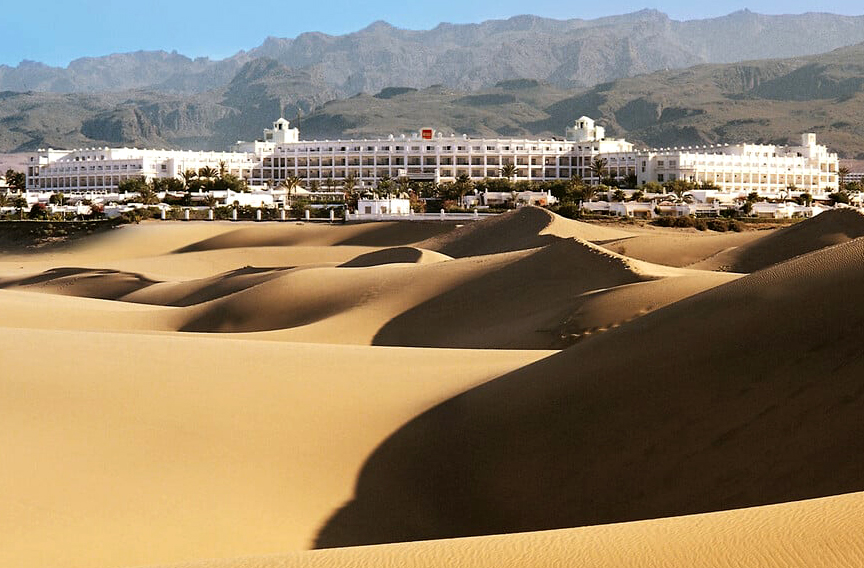
It could be the edge of the Sahara – but it isn’t. Bordered by the sea, the imagination could even stretch to Namibia’s Skeleton Coast – but it isn’t that either. The answer, and some might feel rather more prosaic, is the southern tip of Gran Canaria.

Here the surprisingly golden sands with their impressive dunes, stretch as far as the eye can see, at least in three directions. Turn to the fourth and the illusion of an unending desert is ruined by the massive Hotel Riu, from which an arrow-straight road leads through the popular resort of Playa del Ingles.
On my first visit there some years ago, it was possible to wander at will across the whole area of the dunes at Maspalomas and be completely isolated from the sun-worshippers by the sea and around the hotel pools. The sand was dry, powdery, and hot and the vegetation, with its grey trunks and limbs with sharp thorny leaves, were only just, one felt, surviving. Today, with increased visitor numbers and greater concern for conservation, the local authorities have marked a limited number of routes to which one is required to stick, on pain of a 20 euro fine for straying off the beaten track.
Even allowing for current restrictions, with nearly 1,000 acres there is still plenty to explore. In those areas between dunes, when all signs of humanity are out of sight and only the occasional palm tree among low bushes breaks the horizon of golden sand, the illusion of a desert remains very real. On a cloudless day – and there are plenty of these in this part of the island – the heat can be intense and while an explorer’s pith helmet might be considered over the top, some form of head covering and a bottle of water are advisable.
The area even has an oasis in the form of a lagoon, found as you approach the seashore end of the dunes, and partially surrounded by palm trees. The desert illusion and the tranquility can, however, be shattered by the sight of tourists riding on slightly scruffy and tired-looking camels.

But why is this desert even here? A total contrast to the rest of the island. The answer, we are told, is that the eastern end is formed extensively from the remains of molluscs washed up over the centuries, while the remaining area is fed from a ravine, several kilometres wide, that has deposited its sediment here. These natural deposits have formed mini hillocks on which vegetation has grown, more or less locking them in place. Natural movement and erosion mean the whole area will have periods when it increases in size and others when there is a decrease. At the moment it is going through a period of expansion. Still, like so many fascinating parts of our world, it is potentially endangered by human activity which has led to the current restrictions on greater public access.
The monolithic Hotel Riu that overlooks the dunes and desert may well, and with some justification, be regarded by some as an eyesore. It does, however, have one distinct saving grace, providing much-needed cold refreshment after several hours of exploration – excellent ice cream!